What was life like before generative AI?
It’s hard to believe it hasn’t even been five years. Since 2022, AI has advanced at breakneck speed, fueling the rise (and sometimes fall) of enough companies to last a lifetime.
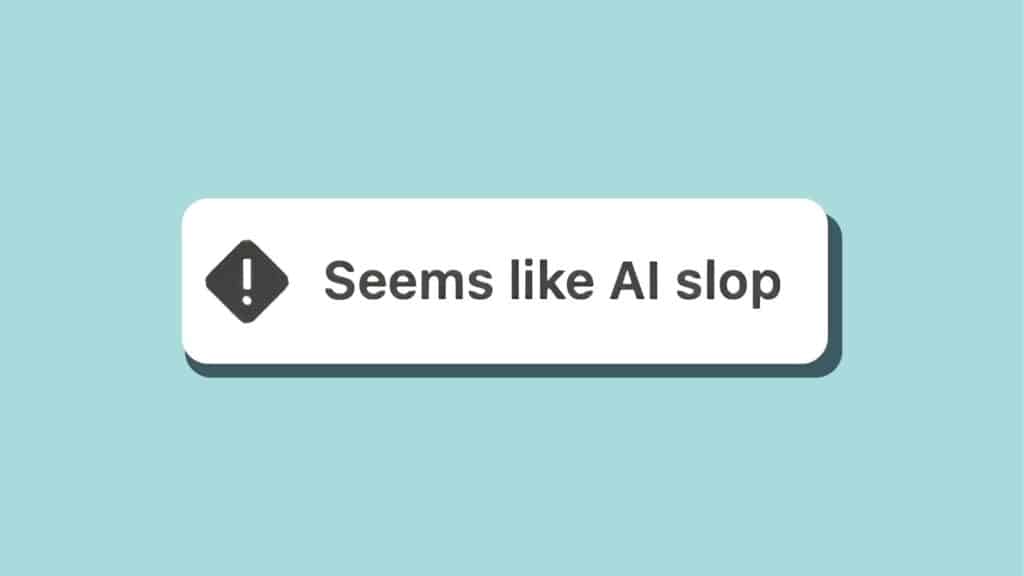
In the past month alone, Reddit lost nearly 90% of ChatGPT citations in under a week — ruining multiple GEO strategies in parallel. Anthropic announced it would start weaving an “imperceptible” watermark through content generated by Claude, with other major players vowing to follow suit in certain markets. And (perhaps most importantly) LinkedIn introduced the “Seems like AI slop” button, which users have embraced enthusiastically. The platform also shared that accounts copy-pasting AI-written content saw 40% fewer views on average.
These updates signal… something. Perhaps not the end of AI in content creation altogether, but the beginning of something more normal: a pragmatic understanding of where these tools help, and where they don’t.
The evolution(?) of AI-generated content
AI content generation’s early days saw companies going all the way in on “all in” — erecting entire strategies and workflows with nothing but a dream and a $20-to-$100 Pro subscription to their LLM of choice. For the most part, it worked. A small group of people generated hundreds of blogs, emails, website copy, video scripts, post captions, and even images in a fraction of the time it would have taken to create them manually. Since audiences were not fully tapped into what it all meant, it served its purpose — and in some cases, it put content marketing teams on literal notice.
But over time, and as more tools became accessible to a wider range of consumers and companies alike, the homogenization of content ensued — and patterns in what the machines considered “good” content became more apparent. Em dashes were the first telltale sign before the lack thereof became a red flag, and then colons took both of their places. “It’s not X, it’s Y” framing was the Pavlovian signal to mentally check out. Sentences that started with “Here’s” or “There’s” were allegedly neither here nor there for online audiences, but still made many an eye twitch.
And yet, the newfound marketers’ AI stack towered higher… until it didn’t.
The most recent updates to platforms and tools have leveled the stack, triggering a reset of expectations around what a “good” content program actually looks like. Earlier iterations incorrectly framed volume as the bottleneck on content that could quickly be solved with more inputs — and soon, every user was running their messaging hundreds of times through the same handful of models, trained on the same inputs as their competitors and adjacent companies. Over time, outputs converged, and content across competitive sets started to look and feel exactly the same… like, “just swap the logos from marketing materials and it would all still align”, as Advania UK CMO Tara Allison puts it. But it didn’t matter, because teams were being frugal in their efforts to “solve” the problem – not realizing that they were slowly creating an even more expensive branding one to address in the future.
A content program is only as good as what goes into it — and a prompt isn’t enough. Great content draws on human experience to express a distinctive point of view, earn attention, and move people to act. AI can eliminate the blank page, but it can’t feel, respond to the moment, or build real relationships. In other words, it can support a resonant campaign… but only trusted human teams can create one.
Best practices for AI in the content workstream
As a general best practice, content teams should be composed of writers who have strong opinions about what a brand sounds like, and strategists who understand why any of it matters at all. But that’s not to say that AI can’t play a role in the process — it absolutely can, just as an assistant that accelerates what the team already does well, so they can focus more time on making it memorable.
For digital content teams at Inkhouse, this looks like using AI as:
- A research assistant. There is no such thing as a stupid question — especially not within the privacy of a chat window. Start with questions about competitors and trending topics in the category, and verify the outputs through linked sources and deeper research before manually building a strategy on top of them.
- A subject translator. For marketers at B2B tech organizations, prompt the tool to share a high-level summary of a published engineering blog, technical concept, or product page. But always confirm with an SME before creating net-new marketing materials for any subject.
- A devil’s advocate. Before any piece of content is sent for review, try to “break” the post through a brutally honest read of it — including obvious counterpoints, where the brand’s logic fails, and what’s already been said across the competitive set. From there, manually fill in the gaps with additional context, as available.
- A high-level analyst. Most models can spot patterns across formats, topics, visuals, and cadence that are pivotal to optimizing future calendars, but hard to see without the 30,000-foot view. How a brand chooses to optimize, however, still lives with the human strategist.
What’s missing from all these use cases is the content itself — which still demands creativity and a distinctive point of view. Brand evolution is a journey humans must lead; no tool can take it for them. Trust your team to create work that genuinely connects, and keep AI in the arsenal for the tedious stretches along the way.
Need a content team that understands your audience and voice? Work with us.