San Francisco is so back. I know this (and you can trust me) because I recently spent a week there, gazed at the Pacific, devoured Laundromat bagels, and enjoyed moments unique to SF and SF alone. The city, truly, was buzzing with life.
HumanX, the conference focused on real-world AI applications and actionable insights, felt like a physical manifestation of that energy. For a conference about the technology many people fear will replace us, it was far less spectacle and more human-to-human connection.
At the event, it was clear that people have moved past asking what AI can do and are now grappling with what its rapid spread means for them and for the world. And instead of avoiding that discomfort, spaces like HumanX are leaning into it, creating room for more honest, grounded dialogue.
Here are the biggest conversations that happened at HumanX conference this year:
1. DC and SF are closer than they appear
Axios Senior Tech Policy Reporter Ashley Gold led discussions on European AI policy, AI governance, and what responsible deployment really looks like (hello, AI agents!). Our favorite question of hers: Who protects the public in the age of AI? According to Ashley, “Silicon Valley is trying to figure out who is driving the bus.”
That thread keeps resurfacing, not just at HumanX but across the broader landscape: how (and, maybe more importantly, where) power is shifting in the U.S. federal AI policy landscape. Is it Silicon Valley or our nation’s capital? Jasmine Sun, an SF-based writer covering the institution from within the culture, puts it this way: the balance of power between tech hubs and policymakers is still very much in flux.
Our CEO, Jason Morris, has frequently underscored the urgency of this moment, noting that “every company has political exposure in 2026, especially during a midterm election year when nothing will be off limits.”
The stakes are escalating. While the industry often centers on security and governance, the conversations at HumanX made it clear that other risks are just as urgent and far from solved. Building AI that will help us progress while remaining safe and trustworthy requires real alignment between the private and public sectors, and the decisions we make today will define the trajectory of AI’s overarching role in society.

2. People (still) want to see practical applications of AI
Improving healthcare outcomes, streamlining child welfare, transforming frontline services—people are less and less interested in the theoretical implementations of AI and more so in what it can actually do for human beings. They’ve been hearing promises for years; now they want to see those real-world improvements actually show up. Take it from Eric Newcomer, who noted that “foundation models are moving out of abstraction and into physical industries.”
Turning promise into practice isn’t straightforward. Inkhouse client Binti’s co-founder and CEO Felicia Curcuru put it well in a discussion on AI governance: “Some of these conversations might feel like theater, but they are real conversations.” Government is deeply embedded in how AI evolves, with some agencies trying to shut it out and others taking a far more permissive stance. Neither extreme works. The real challenge is finding a balance that enables innovation while ensuring accountability and impact. For enterprises, that opens an opportunity to act as true partners to their customers in the AI wild west, offering the guidance the government isn’t providing.
3. Compute is a bottleneck, but not the only one

But what’s going to make this world-changing improvement possible? Some believe it’s continued investments in computing. In a conversation with WIRED’s Lauren Goode, Sumit Sadana, CBO of Micron Technology, and Mark Papermaster, CTO of AMD, discussed how demand for memory and storage is reaching historic highs, pushing the limits of current infrastructure. Hardware now has to keep up with the scale and speed of AI models, and enabling real-time intelligence depends on how quickly we can reinvent compute, memory, and power efficiency.
At the same time, there’s a growing question of how much scaling compute alone will actually move the needle. In a fireside chat with CNBC’s Deirdre Bosa, Databricks, an Inkhouse client, co-founder and CEO Ali Ghodsi noted that even a 10x increase in pre-training spend may yield only modest, linear improvements. In his view, today’s models are already highly capable; what’s missing isn’t intelligence, but context. Models perform best when they have clear instructions, high-quality data, and systems designed to support them.
4. People love to get outside during a conference week
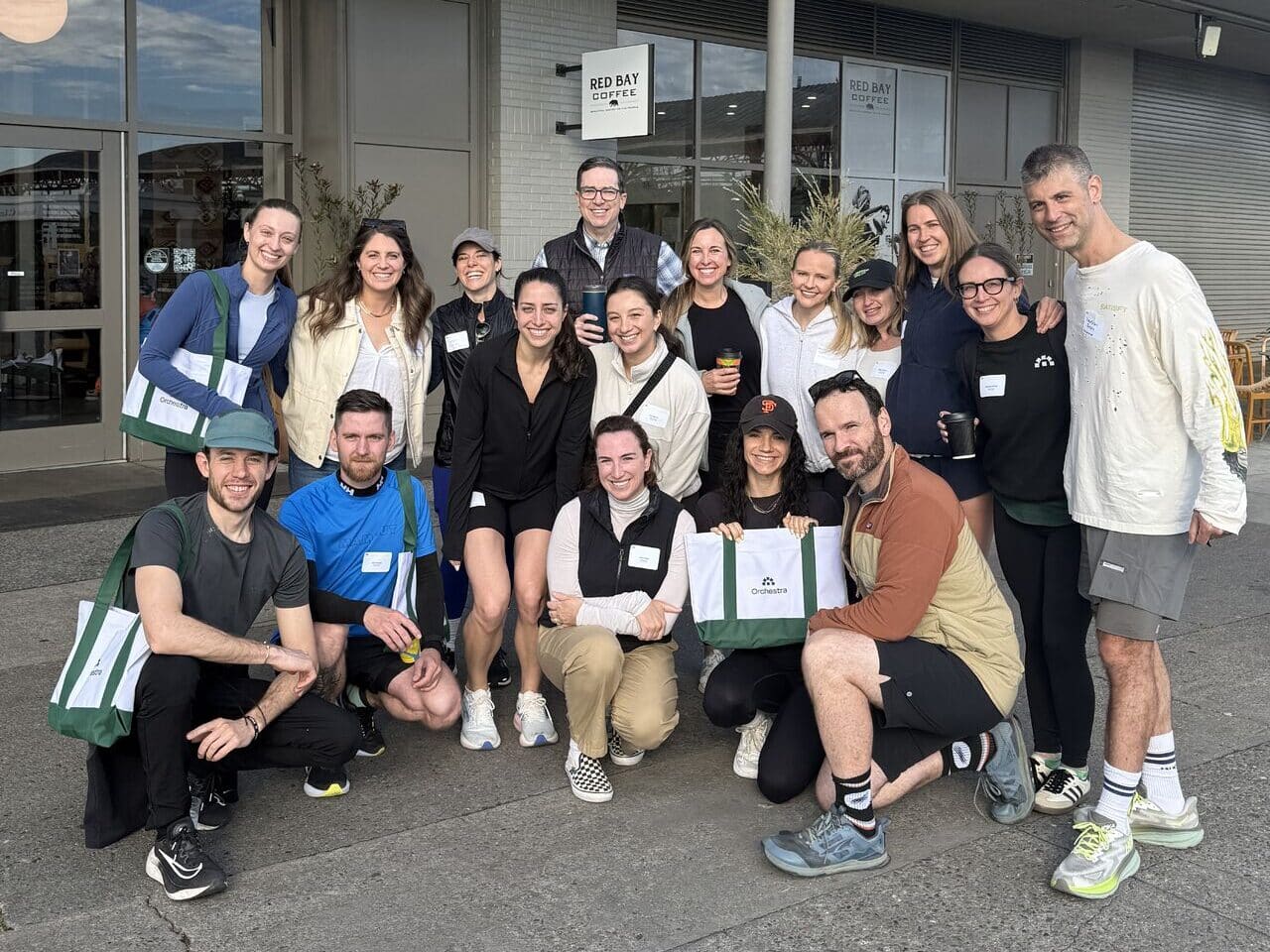
Pros of the conference floor: immersive demos, sharp conversations, nonstop networking. Cons: almost no natural light. We partnered with HumanX to fix that.
Halfway through show week, we gathered with HumanX attendees and members of the San Francisco tech and communications communities to enjoy a blissfully sunny morning along the Embarcadero. It was a fun run, a fun walk, and we can confidently say that endorphins and caffeine are still a good combo.
More than anything, we were grateful to hear the same line over and over: “It’s great to get outside during conference week.”
Were you in SF for HumanX? If so, what did you think? We’d love to connect, hear your thoughts, and feedback at [email protected].